Showing posts with label alternative energy. Show all posts

Wednesday, September 10, 2008

"Green Collar" Jobs

Report: $100 billion would foster 2 million green jobs

According to the above cnet news article if the government would invest 100 billion in creating green tech jobs we would be able to create roughly 2 million jobs. Here is how the 100 billion dollar investment would be broken down: about 50 billion would be tax credits to businesses and homeowners, 46 billion would be in direct federal spending and about 4 billion would be in loan guarantees. All of this investment would equal to about the same amount spent on the recent economic stimulus package, according to the cnet article. This would have been money better spent. It could give people something they actually want and need, a job, instead of a "stimulus" check that probably wouldn't even last a month.

The jobs created from an investment like this would range from generating new technologies to progress the use of biofuels, alternative energy sources, etc.. to jobs that would update current infrastructures like buildings, the power grid, rail, etc... to be more energy efficient.

Now I am not sure if all of this job creation would truly happen but our country has to invest into this stuff eventually if we want to avoid economic collapse so doing this now should help. Plus maybe we can get at least some of those 2 million jobs at the same time. I just fear that this investment would go to technologies that have little or no hope, like ethanol or a hydrogen vehicle. Now hydrogen potentially has a spot in our future as an energy storage source but we will save hydrogen for a future post.

Sunday, September 7, 2008

Advancing Wind Power

GE is looking into several technologies that would advance wind energy in two ways: efficiency and reliability. GE is looking at using carbon composites, instead of fiber glass, as a material for wind turbine blades. GE is also looking at using different shaped blades in order to catch more wind, which will could allow the blades to rotate at slower wind speeds. Using carbon composites will give the blades increased strength which will allow the blades to operate at faster wind speeds as well as the ability to generate more energy. With the combination of longer blades, increased strength and different blade designs, GE hopes to increase the amount of energy generated from turbines without having to significantly increasing the size of the turbines. Increasing the size of the turbines means more raw materials, like steel, which also means more cost to GE and to their customers. GE hopes to keep costs down as much as possible while still increasing energy production from a wind turbine, this is important in order to keep wind energy an important, cost effective alternative energy source.

One of the biggest downfalls to wind energy, like solar, is the lack of consistency that can occur. Because wind turbines require the wind to create energy, if the wind is not blowing very hard or at all you are looking at less or no energy being produced. This can create disturbances in the power grid and power outages in areas of the country. Typically natural gas plants are used as backup power because natural gas plants can begin producing electricity relatively quickly and inexpensively when compared to other power plants, like coal. Due to the inconsistencies that can occur in wind power generation some are against wind power, while others have embraced wind as a viable energy producer. Supporters of wind acknowledge that it is not a perfect energy source, no energy source is flawless. Instead of giving up on wind energy they are developing methods that can be used to help improve the consistency of wind. GE is researching smart turbines and looking at ways to help develop a smart power grid to help alleviate this problem. GE hopes to you use software to find the best placement of wind farms and placement of turbines within a wind farm. GE is also looking into electronic control devices that would feed the power grid more efficiently and effectively. GE believes that if they can improve the turbines and the delivery of the power into the grid that many consistency problems can be largely improved. Others are looking at ways to store excess energy that can be used during times of limited wind or high energy demand. Companies like Energy Storage and Power are developing compressed air energy storage solutions. Basically a simplistic explanation of a compressed air energy storage is this: excess energy from the grid would be used to compress air that is stored in a storage tank. When the power grid is asking for more power than what is being produced the compressed air would be released from the the storage tanks and used to create energy. Now naturally there is some energy loss during the conversions but some of this excess energy is wasted anyways so at least this is a way to harness it at a later time.

Thursday, August 28, 2008

Solar Being Put to Use!

I know this is an older article but I wanted to post something about it anyways (click on article title for link). California, whether you consider it good or bad, is forcing utilities, like PG&E, to have at least 2o percent of their power generation from renewables by 2010. PG&E is planning on installing two large scale solar plants to generate 800 megawatts of electricity. Both plants should be up and fully operational by 2013. This is enough power generation to support roughly 250,000 homes a year, not too shabby.

I know some people disagree with California (or any state) demanding that power utilities have a certain amount of renewable power but I myself find this to be one of a few ways to get renewable power generation increased. You can also give tax credits, for example. I do commend PG&E on their efforts here, solar power is going to be a big part of our future and installing such a large scale plant in very adventurous and costly. I hope this can create and example and trend for more companies to build renewable power generation plants, instead of coal, natural gas, etc.... We can not continue in our old ways or society is going to feel tremendous pains.

Saturday, August 23, 2008

Solar Energy from Roads?

I have been reading about using roads as a solar energy a lot lately. I personally like how people are thinking out of the box with these proposals. With thousands of miles of asphalt-roads that attract large amounts of heat, we might as well use that heat for something. There are two different proposals that I would like to talk about.

The first proposal would use our current road building practices and add an additional layer to the road. This additional layer would be a few centimeters from the surface and it would contain heat exchangers. The idea is that you would take the heat absorbed by the road and use water to heat buildings or to generate electricity. Now as interesting at this sounds, the amount of water needed for this project basically makes this a pipe dream, if you ask me. We can't use water, that we need for drinking, to sit in a huge pipe infrastructure under our roads. If we can develop a method to use a different liquid I would have no problem with this idea. (Source: Science Daily)

The other proposal that I am going to talk about required even more creativity. A company called Solar Roadways, has came up with a theory (still in early development phases) that would use the nations road system to generate electricity in a very interesting way. Basically the idea requires the road making process to be changed because the materials used would change. The roads would have glass solar panels built into them that would generate electricity. These panels would somehow have to be built into the road and have the strength to withstand traffic. Again, this is another very interesting idea and with some more work it could become a reality. (Source: Tree Hugger)

Keep in mind that even as cool as all of this sounds, the amount of money needed to actually put these ideas to work is in the billions of dollars. With a price tag like that and the fact that these are both very immature ideas we may never see any of these outside a lab. The other very important item to consider is the amount of energy each proposal would take to put into practice. Each proposal would require the roads to be repaved, new materials to be produced, etc... Let us hope that if nothing this sparks another persons mind to continue this work and to hopefully give us a working solar energy system to incorporate into our roadways.

Wednesday, August 20, 2008

Google Invests in Energy

According to an article at CleanTechnica's website, Google.org, the philanthropic arm of Google, has invested close 10 million dollars into Geothermal. This investment is supposed to help progress the use of Geothermal energy, among other things. Geothermal uses the heat under the earth's surface to spin turbines to create energy (electricity for the grid). Geothermal plants run continuously and if built correctly, seem to be renewable.

If a geothermal plant has a larger capacity than what the geothermal location can supply eventually the geothermal plant's energy production capacity will decrease. Eventually if things are unchanged the geothermal plant can cease to produce energy due to the geothermal location not being able to replenish the heat within geothermal formation. If, however, the plant lowers it's production levels or stop operating for a time it is possible for the geothermal formation to replenish itself.

With the attention and funding from a company like Google, geothermal energy might be given a little extra boost. Geothermal is a promising resource that if used correctly could offer many lasting benefits.

Tuesday, August 19, 2008

Algae Crude

About a week ago a friend of mine pointed me to a company called Sapphire Energy. Sapphire Energy wants to use Algae to make a fuel like many other companies are but the thing that makes Sapphire Energy different is that they are trying to make "algae crude." What makes this idea so exciting and promising is the fact that they are aiming to create a system that will create a fuel that is chemically identical to crude oil. Yes, crude oil, this would allow for there fuel to be completely compatible with all of the current energy infrastructure like vehicles and the distribution chain. The idea of creating crude from something like algae isn't entirely new but the concept has not been extensively explored. Hopefully Sapphire Energy can pull this off, feel free to visit their web site and check them out, http://www.sapphireenergy.com/. They go into more detail about the algae-to-gasoline concept on their Green Crude Production site.

Sunday, August 17, 2008

Biodiesel as a Biofuel

In my previous posting I talked about ethanol. I know there are other promising ways of producing ethanol but lets be honest, nothing from the ethanol camp, as of yet, has as much promise as some of the biodiesel production methods. Currently the major source used to produce biodiesel is soybeans. Soybeans unfortunately do not have a very good EROI(Energy Return Of Investment), much like corn does not. EROI is the ratio of the amount of usable energy acquired from a particular energy resource to the amount of energy expended to obtain that energy resource (http://en.wikipedia.org/wiki/EROEI). Basically, energy return on investment is the measure of the amount of energy needed to create biofuel (for example) and then the amount of usable energy you have from the biofuel. If the amount of energy needed to create a biofuel is not significantly less than the amount of useful energy contained in the biofuel then the energy source becomes less and less useful, much like soybeans or corn. Soybeans, at this point, are a major biodiesel fuel source used for mass production. Soybeans have worked as a beginning biodiesel producer but the effects on our water table and environment won't allow them to be a viable mass production source into the future. Rapeseed and canola are better options when comparing them to soybeans but you still have to use farmland to grow a crop, to make a fuel and to power society. This requires the use of farmland, farm equipment, fertilizers and pesticides, and water. Though canola and rapeseed both produce more oil per acre, which requires less farmland, neither of these crops are solutions to the problem. Now I am not against using crops like canola or rapeseed to produce biodiesel in small quantities, but to do so at a scale that would even come close to meeting the diesel demand would be detrimental. We need to stop using food products and valuable farmland to produce fuels, we need to use food products for food and farmland to grow food.
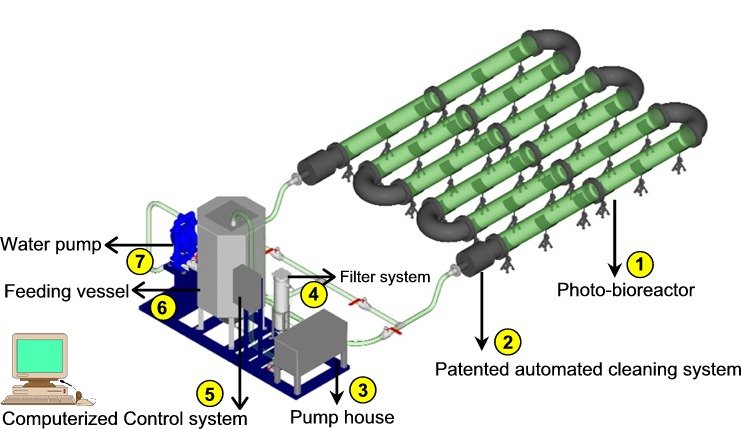
There is one biofuel source that has great promise to alleviate many of the common drawbacks to biofuels, algae. Algae is just now starting to get some of the attention it deserves. Algae can be grown in open ponds and closed systems. Open pond systems have been studied for quite some time but one of the biggest challenges with an open pond system is controlling the type of algae growing in the pond. Naturally open pond systems are susceptible to contamination from outside sources, this is where closed systems excel. An example of a closed system is a bioreactor. A bioreactor is a closed system that pumps water though a network of tubing, the algae is then harvested from the water (http://img.alibaba.com/photo/100453709/Jeruz_Algaelink_Photo_Bio_Reactor.jpg) for biofuel production. Though some closed systems like bioreactors can use more energy than an open pond system and are more complex, the control over the type of algae growing in the system is very beneficial. Companies like GreenFuel Technologies have a bioreactor design that use CO2 from coal power plants to grow the algae within the system, this gives the bioreactor a steady flow of "food" for the algae. Valcent Products has one of the most interesting and promising closed systems that I have seen so far. It uses plastic bags hung vertically, these plastic bags have channels in them to direct the water through a series of paths to maximize the amount of sun the algae is exposed to for photosynthesis. This method is relatively simple in comparison to many other methods used to create biofuels. Valcent thinks their company can create a algae system that can create "...about 100,000 gallons of algae oil a year per acre, compared to about 30 gallons per acre from corn; 50 gallons from soybeans." (http://www.cnn.com/2008/TECH/science/04/01/algae.oil/index.html). If you research oil production from algae you will find the estimated amount of oil per acre to have varying numbers. I am somewhat skeptical that 100,000 gallons of algae oil a year per acre is possible but even if that number is significantly less, like 15,000 or even more conservatively around 1800 like some estimate, it is still a much more viable option than any other biofuel source at this point.
Each biofuel source can and probably will play a role in replacing crude oil with a renewable energy source; but we need to stop giving the majority of the research and funding to sources that will not benefit society. Algae is by far the most promising of all biofuel sources but ethanol may also play a role in the future. Anytime an energy source is considered we must not forget the law of thermodynamics and energy return on investment, these two things will give you the true benefits and negatives of a biofuel.